


Project Update
Thursday 13 November 2025
Strengthening the Internet in Africa
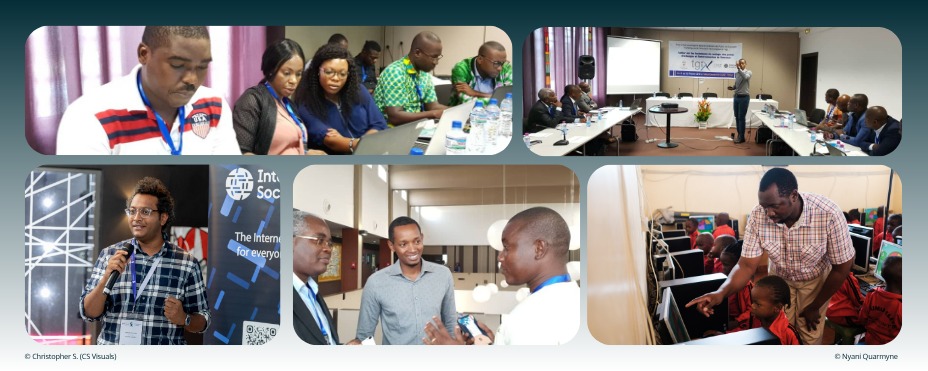
Across Africa, millions of people have gained Internet access over the past decade. But for many, the experience online is far from ideal, mainly because much of their data travels far beyond their borders before reaching its destination. This means higher costs, slower speeds, and missed opportunities.
But in some places, change is underway. Under the Coalition for Digital Africa, an ICANN-led initiative that brings together regional and global partners, the Internet Society is working to expand and strengthen Internet infrastructure across the continent. A key part of this effort focuses on Internet Exchange Points (IXPs), which keep local Internet traffic within national and regional networks. IXPs reduce costs, improve performance, and increase resilience by ensuring data travels shorter, more direct routes.
Countries like Kenya and Nigeria have already shown what is possible when local communities and networks come together to build IXPs. Over ten years, they increased the share of Internet traffic exchanged locally from around 30% to nearly 70%. The results speak for themselves: faster connections, lower costs, and millions of dollars saved every year. These success stories now serve as a roadmap for other countries in Africa working to bring the Internet closer to the people it serves.
Steady Growth Across Africa
More people in Africa are connecting to the Internet every year. According to the International Telecommunication Union, Internet use grew from 25% in 2019 to 38% by 2024. Despite this growth, many structural challenges remain. In several countries, networks are not directly interconnected, which means Internet traffic often travels long distances—even across continents—before reaching its destination. On average, Internet Society Pulse data shows that only 41% of the most popular content consumed on the continent is locally cached. This makes the Internet more costly and degrades the online experience for users across the region.
Still, progress is being made. More IXPs have been deployed, more networks are interconnecting, and local traffic exchange is growing. This work builds on the Internet Society’s 50/50 vision.
“The vision is really about having at least half of Africa’s Internet traffic exchanged locally. The vision sets a clear target and helps guide efforts to strengthen Internet infrastructure and local interconnection,” said Michuki Mwangi, Distinguished Expert at the Internet Society.
With ongoing initiatives to support the deployment of new IXPs in Benin, Malawi, Rwanda, and Madagascar, the Coalition for Digital Africa is creating the conditions for sustainable interconnection that will deliver long-term benefits for Internet users and communities across the region.
A Continental Move Towards Connectivity
Building on the examples set by Kenya and Nigeria, other African countries are taking steps to strengthen their Internet infrastructure through the development of IXPs. In Benin, where only 5% of the most popular content consumed is cached locally, stakeholders have expanded BENIN-IX, the national IXP, and launched a new facility, the Cotonou Internet Exchange (COTIX), with four founding members.
Malawi is also making progress. With two active IXPs, one in Blantyre and another recently established in Lilongwe (LLIX), the country is seeing more local networks exchange traffic directly; LLIX went live in 2025 and already has its first five peers.
In Rwanda, the Rwanda Internet Exchange (RINEX) has become a central part of the country’s growing digital ecosystem. Recent equipment upgrades and training strengthened its role, especially during the 2024 East Africa submarine cable outage, when local traffic helped keep the Internet running more smoothly.
Meanwhile, Madagascar is just beginning its efforts but has made important moves to revive its main IXP, MGIX. With support from grants and local partners, efforts are underway to restore operations, attract members, and build a sustainable peering community.
Together, these stories highlight the growing movement across Africa to build the infrastructure and partnerships needed for a more resilient, affordable, and locally connected Internet. Progress is being advanced through the Coalition for Digital Africa, with the Internet Society and its partners leading the work on IXPs.
